
january
"So how are you better than Browserbase?"
Kernel vs Browserbase for AI agents: 5.8× faster cold starts, 3.72× faster end-to-end performance, 50-98% lower cost, open source infrastructure, MP4 video replay, 12× longer session limits, and 10–20% better bot anti-detection.

Just last week, someone asked us, “So how are you better than Browserbase?”
We get that question a lot, so it’s probably time to write it down so the next time someone asks, I can just send them this.
Performance: 5.8x faster cold starts, 3.72x faster E2E than Browserbase
One of our customers recently benchmarked us against nearly every browser infrastructure provider in the space. We not only had the fastest cold starts, we also had 2x better end-to-end latency than the next-best provider. To independently confirm this, we benchmarked Kernel against Browserbase using an open source third-party tool called browserbench.
Despite benchmarking Kernel’s headful browsers against Browserbase’s much lighter headless ones (1 GB versus 8 GB) and effectively running on hard mode, the results speak for themselves: Kernel is 5.8× faster at creating browsers and 3.72× faster end-to-end. Put simply, you can more than double your browser agents’ performance just by switching from Browserbase to Kernel.
We’ve submitted a pull request to browserbench with the results to correct the current leaderboard, putting Kernel in its rightful place as the fastest browser infrastructure provider.
If you’d like to squeeze out even more performance, our app platform lets you colocate your code with your browsers to cut down on network latency, and our browser pools allows you to maintain a set of pre-warmed, identically configured browsers to lower startup latency even more. Because Browserbase doesn’t offer either, neither was included in the benchmark.


Cost: 50-98% lower cost than Browserbase
We price per second of actual browser usage and never charge for idle time or for proxies. Proxies are relatively cheap for us to run, and they’re required for any serious browser automation, so we don’t see a reason to charge for them. Idle time is excluded from billing because our Unikernel architecture can drop your browser into standby mode as soon as your CDP connection goes idle, so the only thing being used is disk space. When your agent is just sitting there waiting on a third-party API or a human-in-the-loop step, you aren’t getting billed.
Browserbase does the opposite: they charge for browser hours and proxies separately. Billing starts when you create a browser and keeps ticking until you delete it, whether or not anything is actually happening. They bill browser usage by the minute, so a 30-second task is rounded up and charged as a full minute. On top of that, since tasks run much more slowly on Browserbase, each one consumes resources for a longer time.
In practice, all of this adds up quickly, and customers that migrate from Browserbase usually see 50-98% lower infrastructure costs on Kernel for the same workloads.
Trust: Open source infrastructure you can independently audit
While Browserbase’s Stagehand framework is open source, its core browser infrastructure and Chromium fork are proprietary, so it’s a black box for customers. We took the opposite approach and open sourced our browser image and SDKs. Developers from regulated industries like financial services, healthcare, and government that need to know how our code works can go read it themselves.
Observability: MP4 video replays, 12x longer session limits than Browserbase
Many providers, including Browserbase, rely on rrweb for replays. This approach can’t reliably reproduce exactly what happened on-screen, especially for content in other tabs, some canvas content, or media assets whose URLs later change or expire. As of this writing, Browserbase’s own documentation warns their users of these caveats and some of what it does not support:
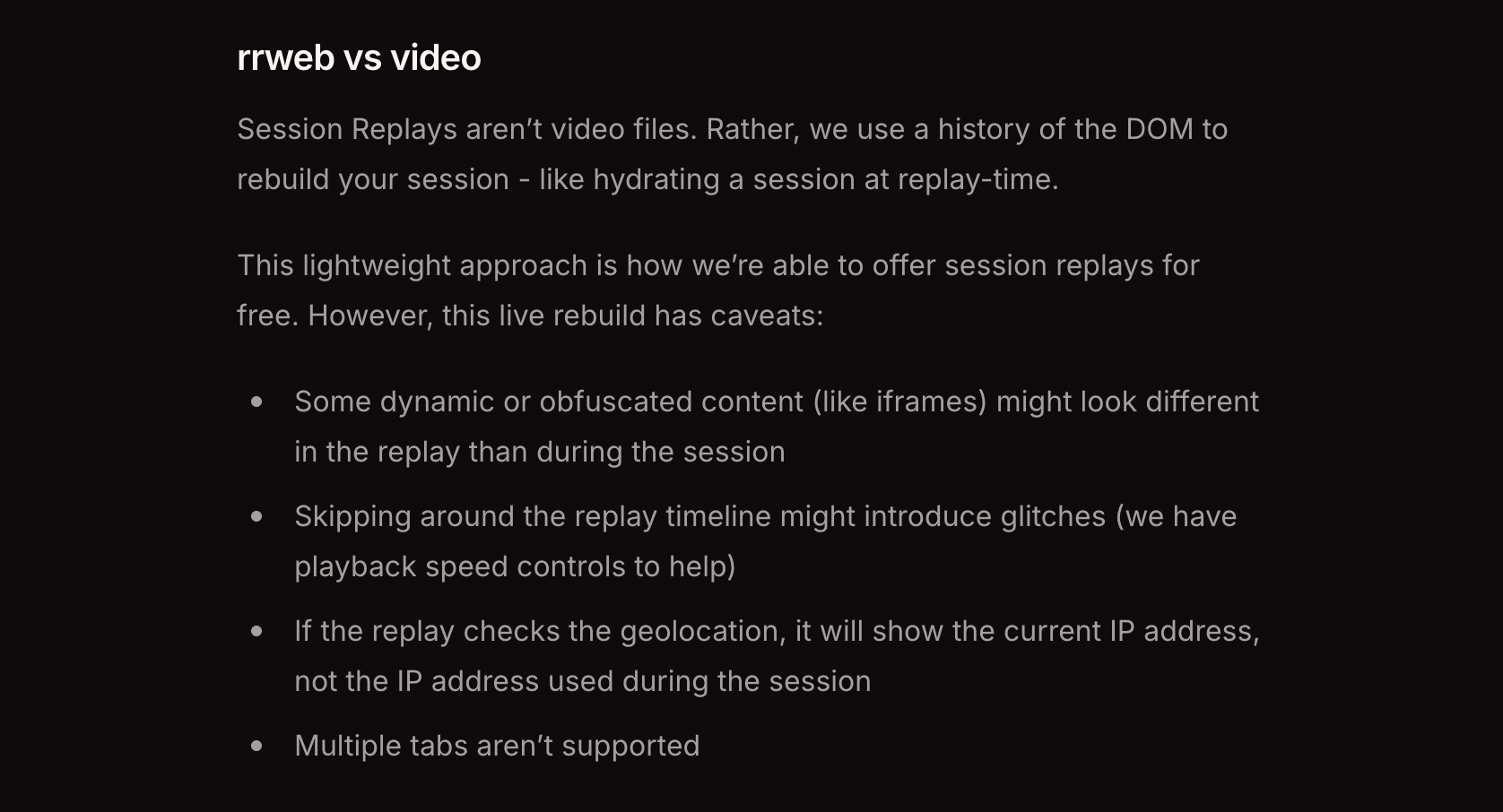
This makes rrweb-based replays hard to use as an audit trail in regulated industries. As an example, we recently worked with a healthcare customer who had to migrate away from a third-party provider using rrweb because it simply wasn’t sufficient. They found a lot of benefit from our MP4 video replays instead, and consider it necessary to support critical operations in the healthcare industry.
We also work with several customers who have human-in-the-loop use cases, where they need to come back the next day to an interactive, live view of the browser where they can take control and approve or unblock something. Many of these customers found this very difficult on Browserbase, because its sessions are limited to 6 hours. We offer 72-hour session limits to support these workflows, so you can pause the browser in the evening and resume the next day — or even three days later — with a live view from the exact same point.
Identity: 10-20% better bot anti-detection than Browserbase
Lastly, identity is the trillion-dollar problem the entire industry is trying to solve. Both of us offer CAPTCHA solvers and proxies (which Browserbase charges for) to help with detection, but Browserbase only provides headless browsers, whereas we offer both headless and headful. We support headful browsers because they can significantly improve resistance to bot detection.
Bot anti-detection is tricky to measure because it depends heavily on the specific use cases and target websites. However, one of our customers cares deeply about bot anti-detection (including CAPTCHA handling), so they benchmarked us against Browserbase on their target websites. They saw Kernel perform 10–20% better, which was the primary reason we won the deal. That’s true despite Browserbase having early Web Bot Auth support, which we’re releasing in a couple of weeks.
Don’t just take my word for it
If you were building a browser agent tomorrow, you’d use Kernel. If you’re a developer that cares about performance, cost, trust, observability, and identity, you’d use Kernel. We’re only going to get better from here. Most importantly, you don’t have to believe me, the benchmarks, or our customer testimonials. Just go try it yourself. It takes under 10 minutes to get started.